
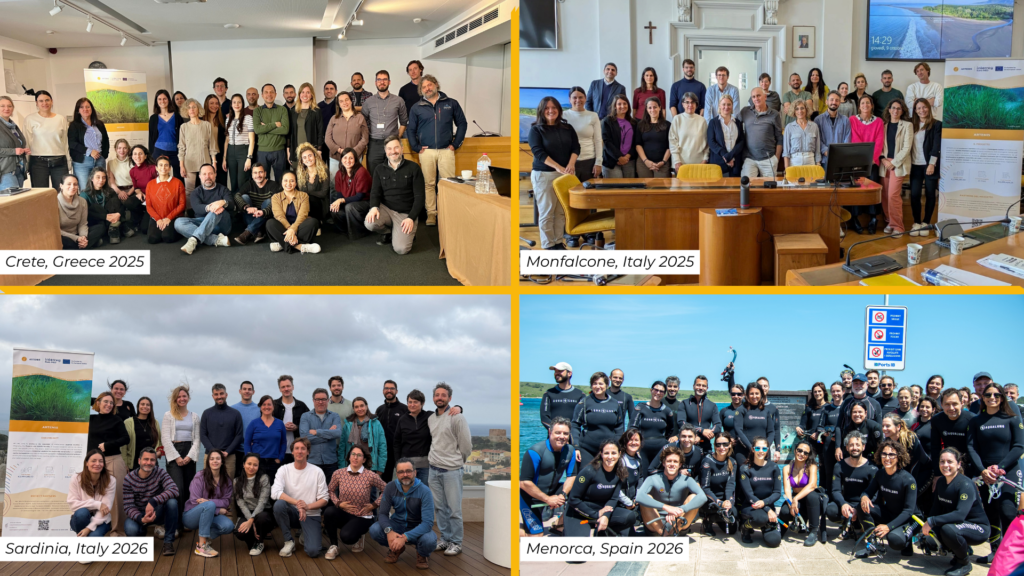
After two and a half years of research, fieldwork, knowledge exchange and collaboration across the Mediterranean, the Interreg Euro-MED ARTEMIS project has come to an end.
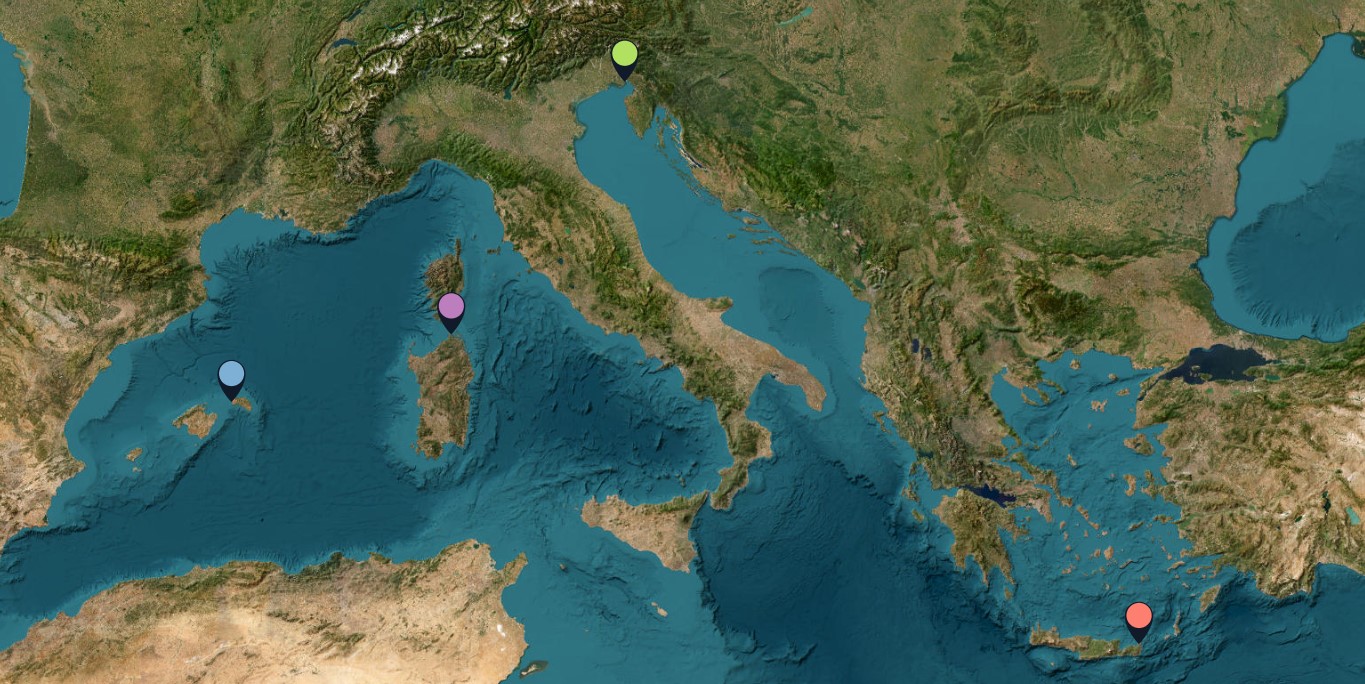
At the centre of the project were four Mediterranean pilot sites, where partners tested restoration approaches under different ecological and socio-economic conditions. But ARTEMIS was never only about restoring seagrass in the water. Over the course of the project, it also explored how restoration can be supported by governance, financing mechanisms, stakeholder engagement, knowledge exchange and emerging approaches for recognising the value of nature.
The result is a body of knowledge, tools and experience designed to support the continued application and replication of Mediterranean seagrass restoration beyond the lifetime of the project.
Four pilot sites, different approaches, one shared objective
Seagrass meadows are among the most valuable ecosystems of the Mediterranean Sea. They provide habitat for marine species, contribute to biodiversity, store carbon, help maintain water quality and sediments, and support the resilience of coastal ecosystems. Yet these ecosystems are under pressure from multiple human activities and environmental changes. Restoring them requires approaches that are adapted to local ecological conditions and that address the pressures responsible for their degradation.
ARTEMIS therefore worked across four Mediterranean pilot sites, testing different restoration and protection approaches for two important seagrass species: Posidonia oceanica and Cymodocea nodosa. Three pilot sites focused on active and passive restoration of Posidonia oceanica, while the fourth explored passive restoration of Cymodocea nodosa. The different approaches allowed partners to compare methodologies and understand how restoration strategies can be adapted to different contexts.
Across the three active Posidonia oceanica restoration sites, a total of 4,400 cuttings were transplanted :
1,300 cuttings, 100 m2 in Greece | 2,000 cuttings, 2000m2 in Italy | 1,100 cuttings, 1800m2 in Spain
The work demonstrated that there is no single restoration method that can simply be replicated everywhere. Site characteristics, ecological conditions, existing pressures, available resources and local management frameworks all influence the choice of approach.
For ARTEMIS, restoration was therefore not simply a question of putting plants back into the sea. It was about understanding where restoration is appropriate, which methodologies can be applied, how restoration can be monitored, and what conditions are needed for ecosystems to recover over the long term.
ARTEMIS closes with more than restoration activities completed at four pilot sites. It leaves behind methodologies, practical tools, policy recommendations, financing approaches, knowledge exchanges and a network of actors working towards a common objective.
The project has shown that restoring Mediterranean seagrasses requires more than technical intervention. It requires knowledge, governance, long-term financing, stakeholder engagement and stronger connections between those who manage, use and invest in natural ecosystems.
The work does not end with the project. The ARTEMIS results and tools remain available to support their continued application and replication, while the experience gained through the pilots can contribute to future restoration initiatives across the Mediterranean.
Our heartfelt thanks go to the entire partnership, whose active engagement gave ARTEMIS its strong visibility across the region and carried the voice of seagrass restoration to new audiences.
Explore the results, share them, and put them to work.
The ARTEMIS Communication Team
THE LEGACY OF ARTEMIS
1. Seagrass Credit System Cookbook
2. Policy recommendations
3. Restoration toolbox
4. Action Plan
5. Investment Roadmap for Corporate
6. Guide for stakeholder engagement and communication
1. Seagrass Credit System Cookbook
Restoration cannot be scaled up through short-term project funding alone. ARTEMIS therefore explored how the ecosystem services provided by seagrass meadows could be better recognised and connected to longer-term financing mechanisms.
The project investigated Payment for Ecosystem Services (PES) and explored the potential of emerging nature-credit approaches as complementary mechanisms for supporting biodiversity restoration. The Seagrass Credit System Cookbook contributes to this discussion by examining how credible seagrass credits could be developed and what conditions would be needed to ensure that financing mechanisms remain grounded in measurable ecological outcomes.
2. Policy recommendations
For restoration to continue beyond individual projects, it needs to be supported by appropriate governance and public policies.
ARTEMIS therefore worked on recommendations and frameworks aimed at helping public authorities integrate seagrass restoration and ecosystem protection into wider management approaches. The project also worked with the four pilot authorities to support the uptake and endorsement of the solutions developed through ARTEMIS.
3. Restoration toolbox
One of the project’s priorities was to ensure that the knowledge generated through the pilot sites would remain accessible after the project ended. The experience gathered through the restoration activities, together with lessons from the partnership and external experts, has been brought together into the ARTEMIS Seagrass Restoration Toolbox.
The toolbox provides practical knowledge and resources to support organisations and practitioners interested in seagrass restoration. It brings together methodologies, lessons learned and experience from the ARTEMIS pilots, making the knowledge generated through the project available beyond the four locations where the work took place. Making these resources publicly available is an important part of ARTEMIS’s legacy: the end of the project does not mean the end of access to the knowledge developed through it.
4. Action Plan
The ARTEMIS Action Plan translates the project’s scientific, methodological and policy results into 25 actions across five strategic lines, refined through Mediterranean stakeholder consultation. It highlights the need to strengthen and better coordinate public funding as the foundation for meeting restoration targets, while using blended finance, private investment and emerging nature-credit mechanisms as complementary sources of funding. The Action Plan also addresses key barriers to scaling seagrass restoration, including fragmented governance, inconsistent monitoring, limited technical capacity and the insufficient integration of restoration into sectoral policies and financing.
5. Investment Roadmap for Corporate
The Investment Roadmap for Corporates translates the ARTEMIS project’s findings into practical guidance for companies interested in supporting seagrass restoration. It guides businesses through the process of understanding the importance of seagrass ecosystems, identifying where they can take action, and exploring investment in restoration through nature credits, while connecting each step to the relevant ARTEMIS knowledge and tools.
6. Guide for stakeholder engagement and communication
ARTEMIS carried out awareness-raising activities across the pilot sites with different actors, engaging local stakeholders including authorities, organisations, fisherman association and communities, ensuring a wider communication of the ecological importance of seagrass meadows and the pressures they face. To support this work, the guide provides a practical guidance on how to identify, value and communicate the benefits that seagrass ecosystems provide to society. The guide is intended to help practitioners and stakeholders better understand these benefits and communicate their importance to different audiences, strengthening the connection between ecological restoration and wider societal engagement.